The goal of the group was to understand the principles governing the evolution of animal societies and the ecological and evolutionary consequences of social life. To study these questions the group combined disciplines of animal behaviour, ecology, evolutionary genetics and genomics. The groups' interests included:
Ageing in social insects
The evolution of eusociality has been associated with a 100-fold increase in insect lifespan. Aside from being exceptionally high, ant longevities greatly vary, both at intraspecific and interspecific levels. First, there is tremendous variation in life span between castes in ants, with queens living over 500 times longer than males and 50 times longer than sterile workers. Second, longevity greatly vary among ant species, from the Pharaoh ant queens that live 6 month to the queen of the black garden ant that can live 29 years. Because of this extreme variability in lifespan, ants constitute an ideal taxa to investigate the genetic causes of extreme longevities. We are using comparative genomics and transcriptomics between castes and species to study the evolution of ageing.
Genetic, ecological and molecular bases for variation in social systems
The number of queens within a social insect colony is an important trait in social evolution. Queen number can be highly variable both between and within species, and we are interested in how and why transitions in social structure occur. In collaboration with Dr. Kenneth Ross (University of Georgia), we have identified a gene (Gp-9) influencing social behaviour in the fire ant Solenopsis invicta. We are currently quantifying the genetic variability of this gene as well as other closely linked genes using a genomic approach. We are also interested in the evolution and consequences of unicoloniality in the Argentine ant. This species has invaded the Mediterranean coast about 80 years ago and there is no aggression between workers from Spain, France and Italy.
Division of labour in insect societies
The major organising principle of social insect societies is division of labour, with one or a few individuals specializing in reproduction, and others participating in tasks such as nest-building, foraging, rearing young and defending the colony. This organisation provides numerous advantages and underpins the ecological success of social insects. While the dynamic allocation of workers to various tasks is a critical aspect affecting colony efficiency and fitness, little is known about the underlying principles. This is because it has been impossible to track large numbers of individuals continuously. We have developed a system based on fiducial identification labels and video tracking to automatically follow all individuals in a colony for extended periods. We will use this system to conduct the first thorough investigations of how environmental factors, social interactions and individual experiences affect the behavioural trajectories of workers. We will manipulate colonies of Camponotus fellah in several ways and track changes in task allocation and in the social network of the colony. We will also test the widely accepted assumption that division of labour increases the efficiency of individuals when they perform specialised tasks.
Causes and consequences of genetic caste determination
Extraordinary cases of genetic determination of reproductive caste have been found in several ants, including harvester ants and fire ants. In these systems, two separate genetic groups must interbreed to produce workers, but produce new reproductive queens only from within-group matings. We are investigating the evolutionary origins of this phenomenon, which appears to be derived from past interspecific hybridisation events, using various molecular genetic markers and the consequences on the biology of the species.
Biological invasions
Biological invasions are among the greatest drivers of species extinctions worldwide and can cause severe impairments of ecosystem services, imposing huge economic costs on society. Ants (Formicidae) are among the worst invasive species, with more than 200 species established outside their native range and 19 listed as highly problematic by the IUCN. We are interested in understanding the mechanisms and drivers of ant invasions at a broad spatial scale. We are developing an integrative framework for predicting invasions based on factors determining species invasiveness and community invasibility. The idea is to investigate the relative role of functional traits, socio-economic factors, propagule pressure, environmental conditions, and native biodiversity in determining introduction probability and establishment success in order to predict future invasions.
Expermental robotics
In collaboration with Prof. Dario Floreano at the EPFL (http://lis.epfl.ch/) we are investigating the role of relatedness (genetic similarity), levels of selection, and group size on the evolution of collective actions, communication and division of labour in artificial ant colonies. We are using colonies of artificial ants implemented as small mobile robots with simple vision and communication abilities. Selection experiments are done with the help of genetic algorithms.
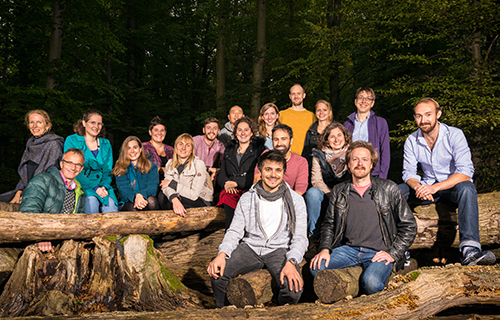
Group Leader
Graduate Students
- Matthias Rüegg (co-supervising by Prof. Selman Sakar - EPFL)
- Luca Soldini
Guests & Trainees
Former Group Members
PhD Students
- Giorgina Bernasconi
- Raphaël Braunschweig (co-supervising with Prof. Paolo De Los Rios, Institute of Physics, EPFL)
- Stephane Dorsaz (co-supervising with Prof. Mehdi Tafti, CIG)
- Eléonore Genzoni (co-supervising by Prof. T. Schwander)
- Barbara Holzer
- Stephanie Jemielity
- Tomas Kay
- Hristina Kostic
- Michael J. B. Krieger
- Rolf Kümmerli
- Philipp Langer
- Adria Leboeuf (co-supervising with Prof. R. Benton)
- Thibault Lengronne
- Cathy Liautard
- Pawel Lichocki (co-supervising with Prof. Dario Floreano, EPFL)
- Sean McGregor
- Sara Mitri
- Drude Molbo
- Mingkwan Nipitwattanaphon
- Robert Price (co-supervising by Prof. C. Grüter)
- Max Reuter
- Tanja Schwander
- Danesh Tarapore
- Shumpei Ujiyama
- Markus Waibel
- Zheng Yan
Post-Docs
- Arthur Bernard
- Cléo Bertelsmeier
- Alexandra Bezler
- William D. Brown
- Michel Chapuisat
- Miguel Corona
- Dr. Hugo Darras
- Michiel Djikstra
- Shigeto Dobata
- Anna Duarte
- Else J. Fjerdingstad
- Denis Fournier
- Erik Frank
- Eduardo Goncalves Fox
- Tatiana Giraud
- Dietrich Gotzek
- Robert Hammond
- Ken R. Helms
- Sarah Helms Cahan
- Dr. Katja Hoedjes
- Brian Hollis
- Giovanni Iacca
- Akiko Koto
- Daniel Kronauer
- Dr. Joanito Liberti
- Romain Liebbrecht
- Christophe Lucas
- Dr. Eric Lucas
- Dr. Sean McKenzie
- Frédéric Masclaux
- Dr. Danielle Mersch
- Dr. Germain Montazeaud
- Dr. Claire Morandin
- Dr. Alba Motes Rodrigo
- Dr. Charles Mullon (co-supervising with Prof. Lehmann)
- Philip Neway
- Michael Nicolas
- Hélène Niculita Hirzel
- Lino Ometto
- Dr. Qiaowei Pan
- Silvia Paolucci
- Joel D. Parker
- Morgan Pearcy
- Jes Soee Pedersen
- Andres Perez-Uribe
- Eyal Privman
- Virginie Ravigne
- Dr. Oksana Riba-Grognuz
- Dr. Tom Richardson
- Dr. Jonathan Romiguier
- Julien Roux
- Dr. Nathalie Stroeymeyt
- Liselotte Sundström
- Colby Tanner
- Paolo Uva
- Julien Varaldi
- Valérie Vogel
- John Wang
- Dr. Chelsea Weitekamp
- Steffen Wischmann
- Yannick Wurm
Période sabbatique
Staff
- Mathilde Arlettaz (Co-supervising by Prof. P. Christe)
- Dr. Raphaël Braunschweig
- Andrei-Lucian Dascalu
- Daniel Guignard
- Ammerins de Haan
- Anabelle Reber
- Céline Stoffel
- Alexandre Tuleu